
December 1 is World AIDS Day, a day to remember those we loved and lost, but also the courage of those who refused to remain silent. Their fight for dignity, visibility and equal rights helped shape the Pride movement we know today. And while much has been achieved, the situation around the world reminds us how much remains to be done. But who does Pride really stand for today?
It all started with our rejected application for Amsterdam’s Canal Parade, which left us wondering: Are we really all equal, or are some more equal than others?
So we asked our ROMEO community: Do you still feel represented at Pride?
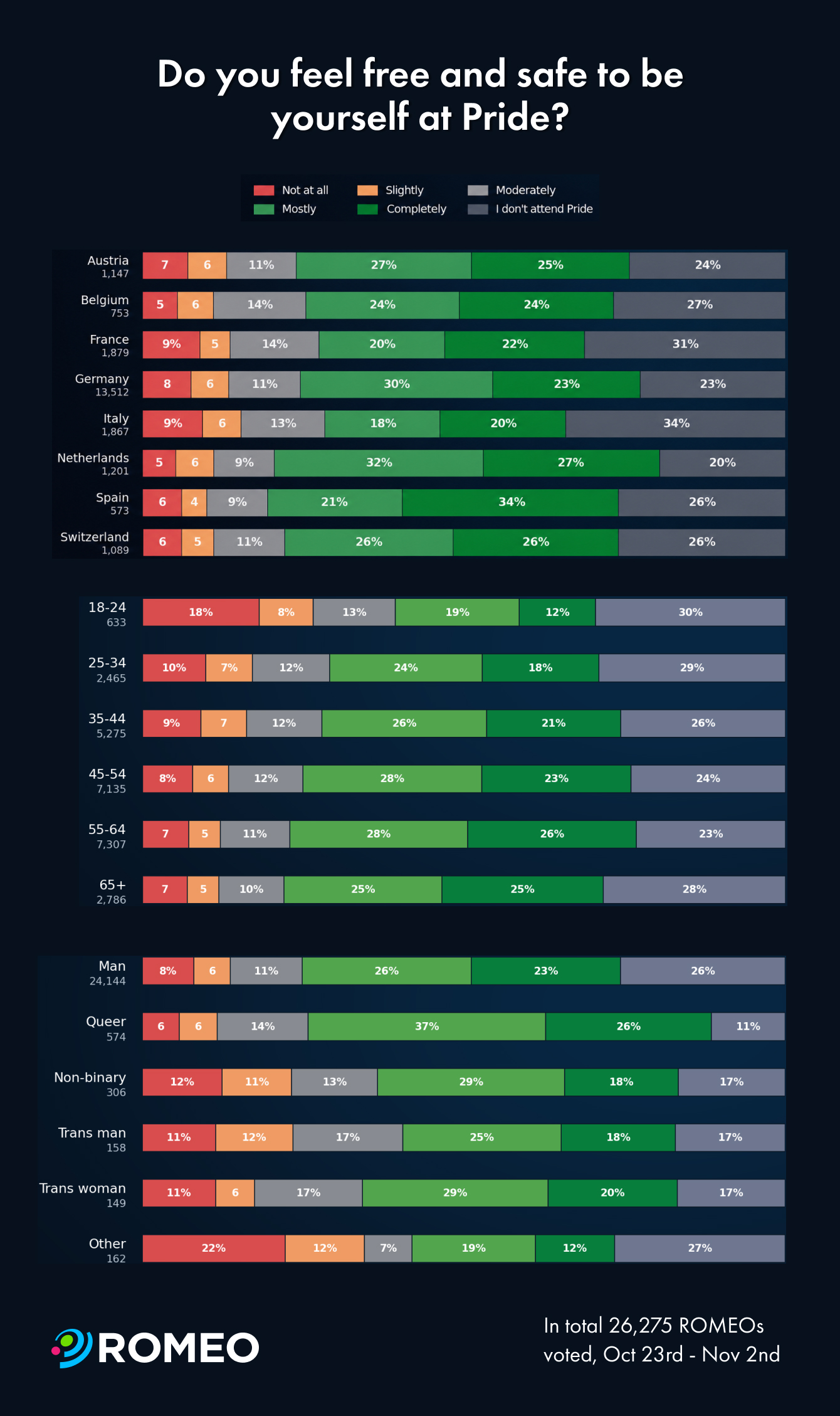
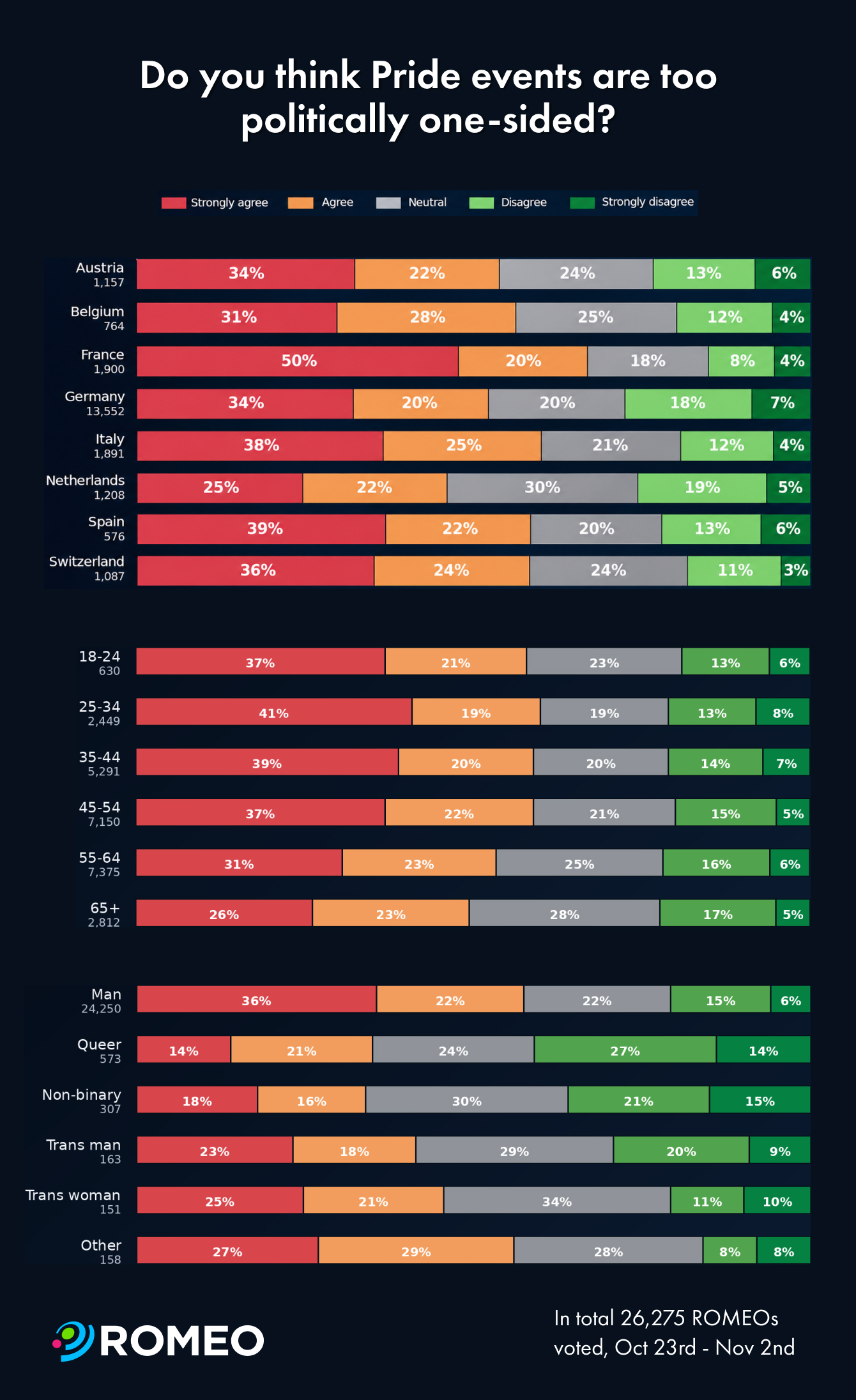
The survey results validated our concerns: This issue extends far beyond Amsterdam, with similar concerns expressed by respondents across the Western world. And the elephant in the room? Widespread criticism that Pride organizations are dominated by activists pursuing their own political agendas rather than representing the interests of the wider LGBTQ+ community.
But perhaps the most troubling part is the spreading fear of speaking openly about it. We would rather leave this debate to others, as ROMEO is first and foremost about Dates, Friends & Love. Yet as members of the rainbow community ourselves, and in the interests of our users, remaining silent is no longer an option.
Here we stand. We cannot do otherwise.
The Results
Overall, do you feel represented at Pride?
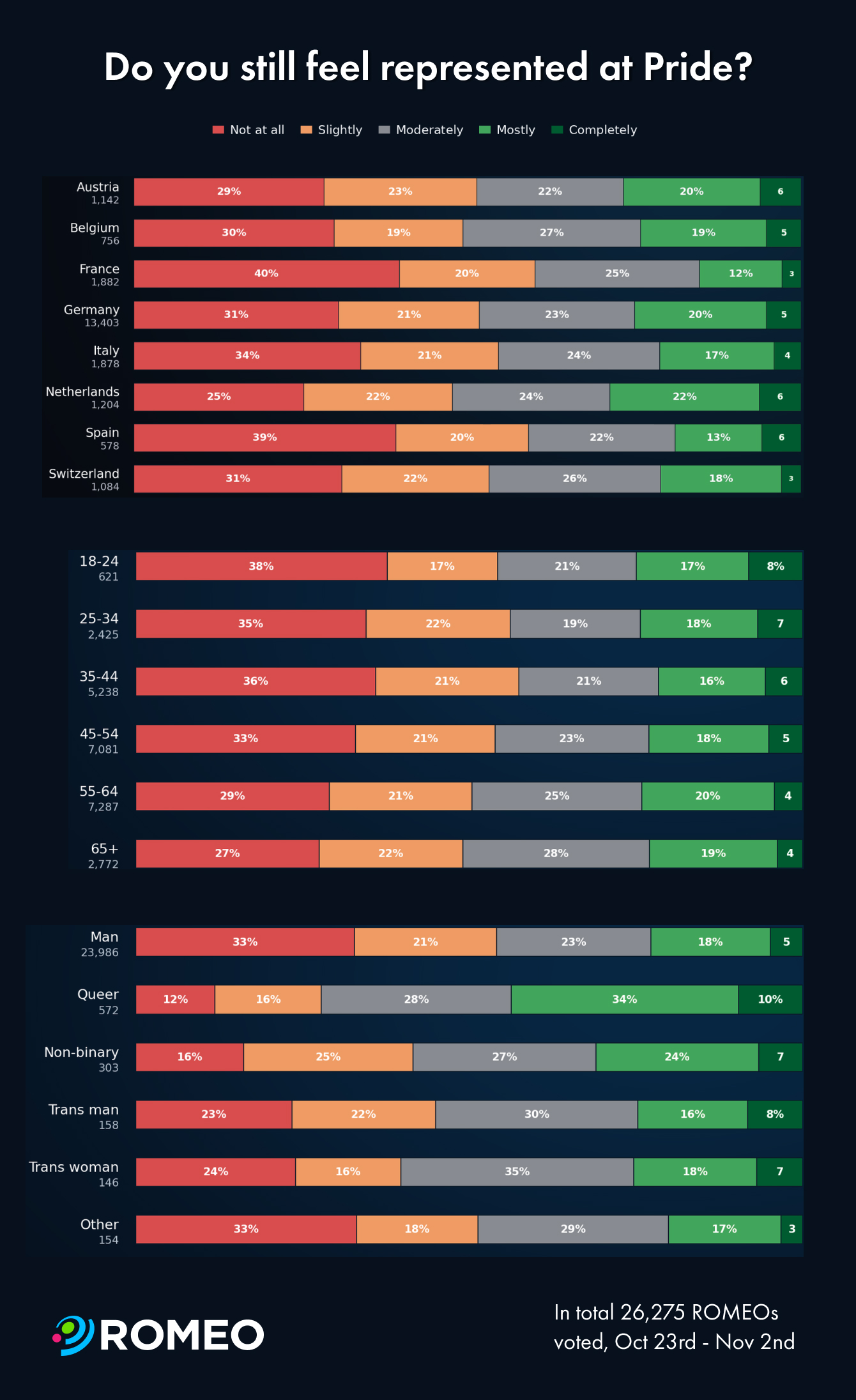
Did you attend a Pride event this year?
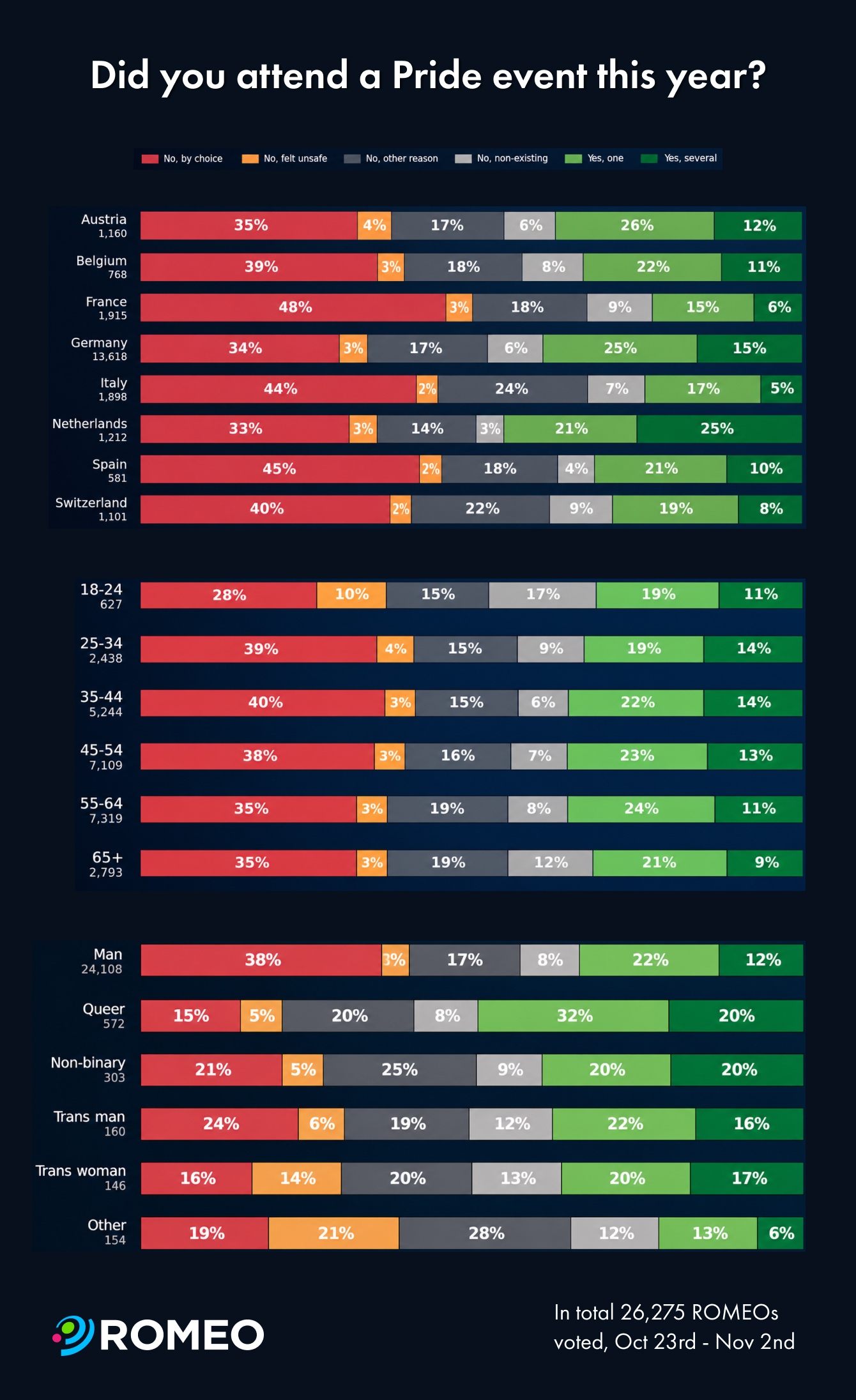
Do you feel free and safe to be yourself at Pride?
Do you think Pride events are too politically one-sided?
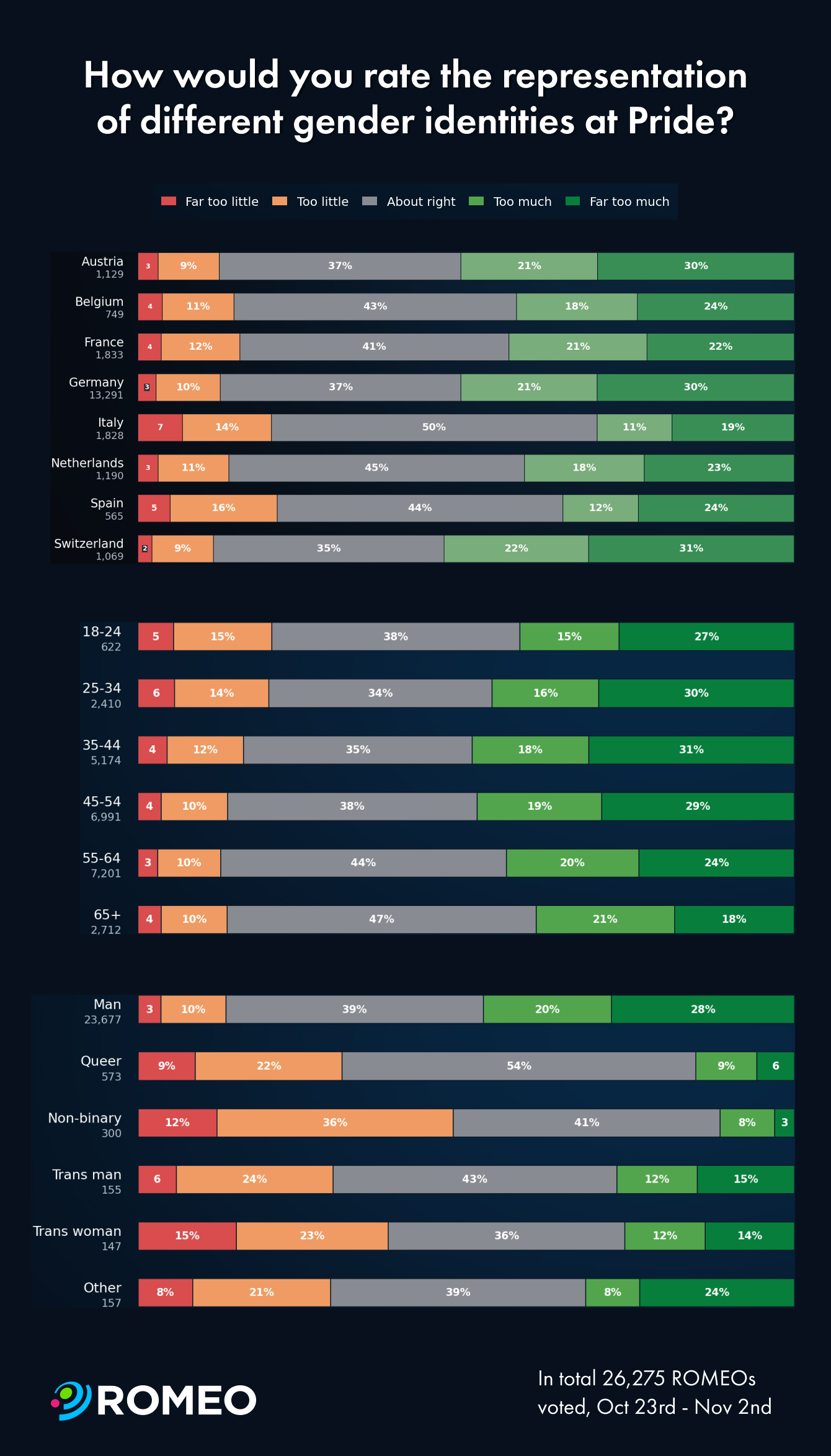
How would you rate the representation of different gender identities at Pride?
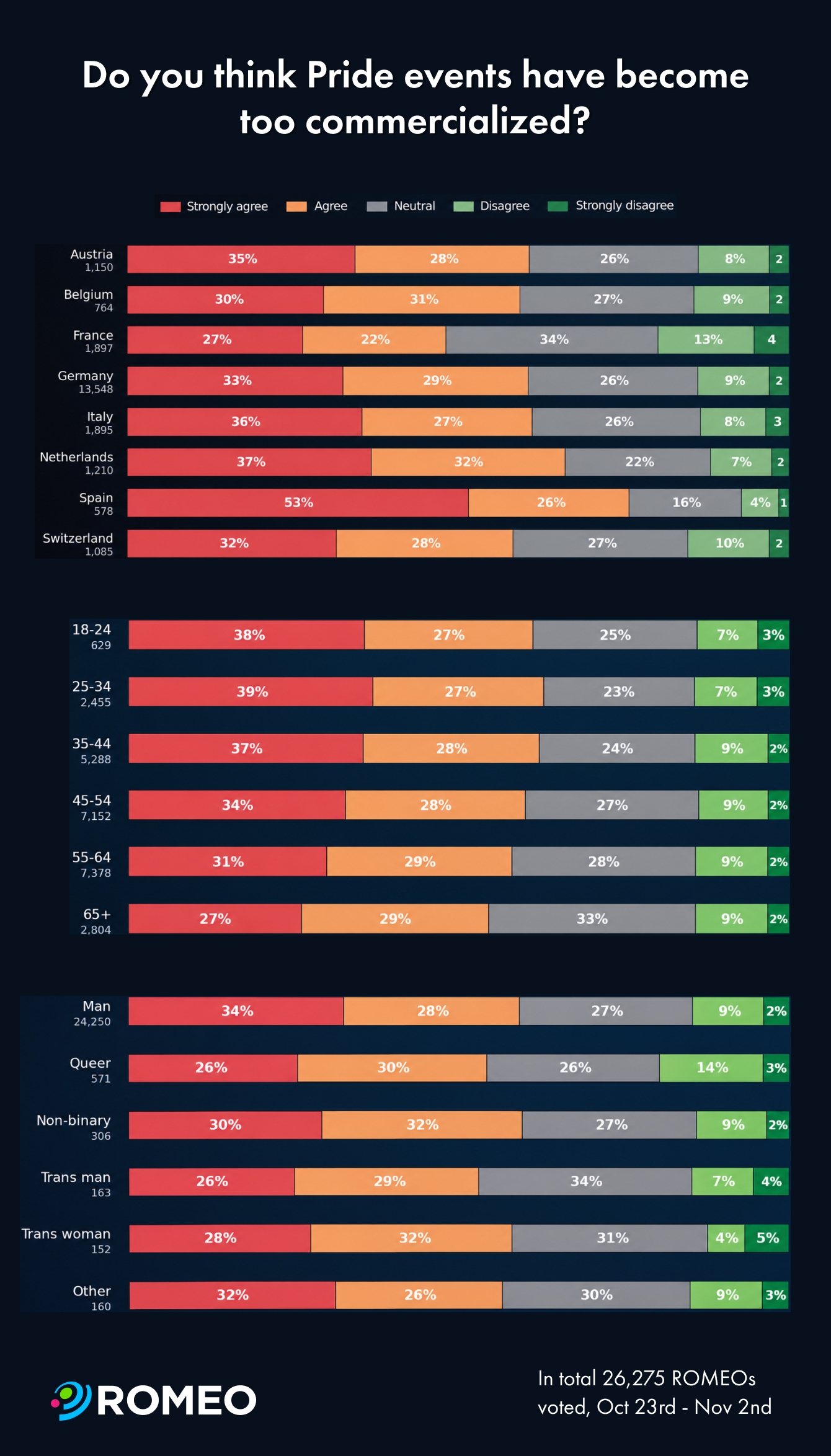
Do you think Pride events have become too commercialized?
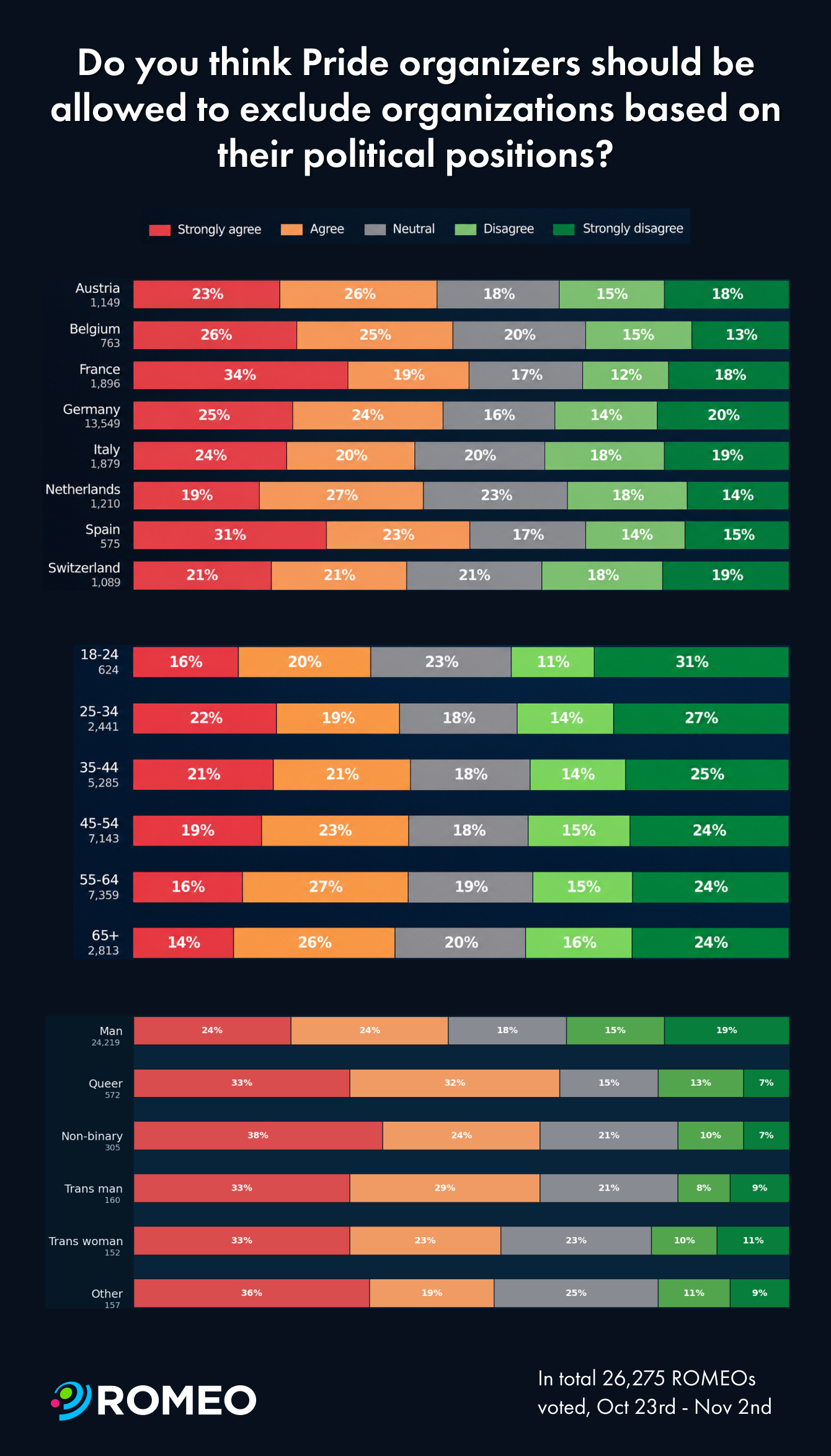
Do you think Pride organizers should be allowed to exclude organizations based on their political positions?
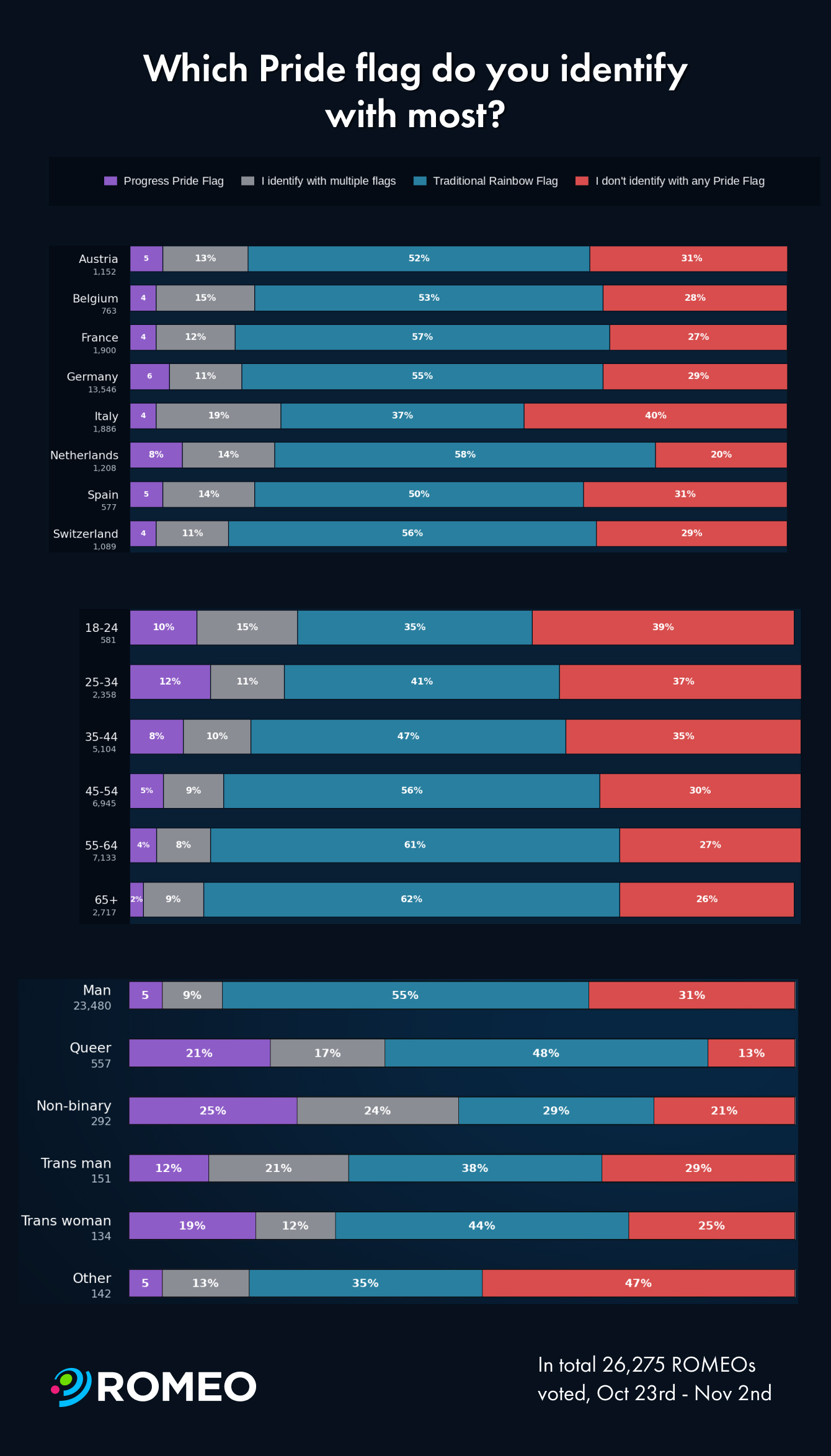
Which Pride flag do you identify with most?
So, What Now?
It may seem unusual that we, as a company, are initiating this discussion. And yes, our survey is based on a self-selected sample and cannot claim to be representative. But much of what it reveals is hardly new. As part of the rainbow community ourselves, we believe these concerns deserve to be heard.
Our survey attracted 26,275 participants and ran from October 23rd to November 2nd. We invited our users through an in-app message and used a survey tool with technical safeguards to prevent duplicate voting.
Reading the results and comments we would like to make a few suggestions for Pride organizers to foster greater diversity, unity and acceptance.
Flags and Labels
The traditional rainbow flag is overwhelmingly preferred, while the newer ‘Progress’ Pride flag receives very little support. Many respondents associate the newer flag with division and politicization rather than unity.
Our suggestion to Pride organizers is simple: Bring back the traditional rainbow flag as our common symbol of unity. Of course, everyone should remain free to wave whichever flag represents them. But let’s put the symbol that unites the vast majority of our community back at the heart of Pride.
The same applies to the use of ‘Queer’. Be yourself, however you’re identifying yourself, and be welcome at ROMEO. But as an umbrella term for our entire rainbow community, our survey shows strong rejection. We should respect everyone’s right to define their own identity, rather than imposing labels on others.
World Politics Divides Us
Hot topic of this year: Among a whopping 8,000+ written comments, 447 mentioned the Israeli-Palestinian conflict, even though we hadn’t asked intentionally about it. Of these, 420 rejected pro-Palestinian activism at Pride, compared with just 23 supportive and 4 neutral responses.
For many respondents, the final straw was seeing Pride organizations not just tolerate pro-Palestinian activism but actively give it a platform (like at the Amsterdam Pride Walk), despite their conviction that world politics has no place at Pride, since it divides and does not unite.
Independence Matters
We understand that Pride costs money and needs sponsors.
But financial dependency can become dangerous. Corporate sponsors may withdraw their support when the political climate changes, either out of fear or because they simply stop pretending to care. Government funding can be equally vulnerable.
We believe that the one-sided politicization of issues within the rainbow community has contributed to a backlash that politicians such as Trump can use to stop funding and justify measures that ultimately also harm communities that unquestionably need support.
Examples include the complete dismantling of USAID, the severe restrictions on PEPFAR, which supports HIV/AIDS prevention and treatment, and funding cuts affecting projects that provide safe houses in Africa, where access to such support can be a matter of life or death.
Diversity and Unity Need Tolerance
We should remember that every person is an individual. Sexual orientation or gender identity does not determine political opinion. Diversity includes the freedom to think differently.
A majority feels that Pride focuses too heavily on gender identity. But a previous survey also shows that trans, non-binary and queer respondents are not a politically uniform group either. Some share similar concerns and don’t want their identities automatically associated with a particular political agenda.
Interestingly, the strongest criticism comes from respondents aged approximately 25–44, while older generations tend to be more accepting.
Sexual Freedom and Consideration
ROMEO has always stood for sex positivity, including the freedom to express our sexual and fetish identities. That freedom is worth celebrating.
But many respondents expressed discomfort with too much sexualization and nudity at Pride.
We should acknowledge however that some people feel uncomfortable or worry that such displays make it harder for Pride’s message to be taken seriously.
When Pride Means Survival
For our detailed analysis, we focused on countries with more than 500 respondents to ensure a meaningful statistical comparison. However, we know that experiences and challenges differ enormously from country to country. For everyone interested in their own country’s results, we have compiled an additional report covering all 51 countries with 10 to 500 respondents.
Download the additional country results (PDF)
Some respondents wrote to us asking for help, describing persecution or expressing their wish to escape their country. Sadly, we cannot provide the individual assistance they need, nor can we even contact them personally, since the survey was anonymous.
Let’s Be Allies Again
We deeply appreciate the hard work and dedication of the many people involved in NGOs and Pride organizations. After all, we share the same vision: a world in which every member of our rainbow family has the freedom to be themselves and pursue their happiness.
There is still so much to accomplish, even in societies where we thought our rights were secure. In the face of growing concerns about homophobia and transphobia coming from all sides, unity is more important than ever.
Our intention is not to blame anyone, but to encourage a moment of reflection. Perhaps taking a step back, being open to different opinions and finding common ground again will bring us closer to our shared goal.
When we as a company see that our actions and work do not lead to the desired results, we have to question our approach and be willing to try something different. Otherwise, we would eventually cease to exist.
Pride doesn’t need everyone to think alike. It needs everyone to feel they belong.
Let’s stop making enemies of each other when we should be allies.